
At a glance
Team: Solo Project Time: 15 Weeks (Spring-Summer 2024) My Role: Service Designer
Tools Used: Figma, Google Suite, Chat GPT, Autodesk Sketchbook
Key Methods: survey, diary study, SWOT analysis, Blue Ocean strategy, Wizard-of-Oz testing, The Grid (strategic business model framework)
The Challenge: About 85% of NFL fans live outside their team’s market, and their engagement drops off significantly in the off-season,
What I did: Ran an 88-person survey and 10-day diary study to design, prototype, and price a year-round fan community service backed by a validated business model.
The Result: In testing, participants trusted the Fan Levels, 5-of-6 said they would pay for the service (3 at $5/month or more), and indicated they would use it daily.
Project Summary
Holding season tickets gave me front-row access to the my team's operational cadence and its blind spots. While local engagement is tied tightly to the team calendar, millions of remote fans remain completely disconnected from the community year-round.
FanTowns is a dedicated social networking and educational platform designed to solve the engagement crisis facing the 85% of NFL fans who live "out-of-market."
The Challenge: Out-of-market fans struggle to access games and feel disconnected from their community. This leads to a massive drop in engagement during the off-season, resulting in lost revenue opportunities for the league.
The Solution: A gamified service ecosystem that bridges the gap between casual viewing and die-hard fandom. FanTowns combines hyper-local community building with a "Learning Center" to increase Football IQ. By incentivizing daily interaction through Fan Points, Rankings, and Trivia, the platform keeps fans active year-round, converting off-season lull into deep brand loyalty.
As the sole designer, I completed all aspects of this project, from initial research, to concept development, and all the way through the final pitch delivery.
In this project I:
Uncovered Market Opportunity: Synthesized industry data to identify the link between off-season engagement and increased consumer spend.
Designed the Solution: Conceptualized "FanTowns," a niche social platform addressing the isolation of the 85% of NFL fans living out-of-market.
Developed Business Model: Created a viable revenue strategy projecting $76.5M/year based on a 15% market capture and a validated subscription tier (in testing, 5 of 6 participants said they would pay a monthly subscription fee for the service: 1 at $10, 2 at $5, and 2 at $3-$5.
Engineered Gamification for Increased Engagement: Created the "Fan Levels" (Rookie to Hall of Fame) system to drive daily retention and long-term user loyalty.
Research & Discovery
To validate the problem space, I utilized a mixed-methods approach combining quantitative and qualitative data.
Quantitative Survey: I surveyed 88 NFL fans about their off-season habits and appetite for more content, then recruited six respondents for a diary study.
Key Insight: While all fans desire more engagement, out-of-market fans expressed a significantly higher urgency for connection than hometown fans.

Longitudinal Diary Study: To move beyond what fans wanted to how they felt, I conducted a 10-day diary study with six participants. Tracking their responses to the same set of daily questions revealed the consistent lack of meaningful touchpoints during the off-season.


Ecosystem Mapping: I conducted secondary research to map the current Service Ecosystem and Value Exchanges, identifying where the current NFL model fails to capture value from displaced fans.
Analysis & Strategy
Following the research phase, I utilized affinity mapping to synthesize the raw data. Distilling the findings, I was able to extract 3 key insights:
1. Fans, especially those living out-of-market, are unhappy with the quantity and quality of offseason content and engagement opportunities with their teams.
2. Fans are seeking a closer connection and better understanding of the game, the business, and the people within football to enhance their viewing experience.
3. Being able to connect with a community of like-minded fans and watch your team play is important, but often-times difficult, especially for fans who live out-of-market.
During this analysis, I identified a critical viability constraint: directly acquiring premium NFL content (player interviews, behind-the-scenes footage) would be cost-prohibitive for a startup service.

To carve out a unique space in a crowded marketplace, I utilized a Blue Ocean Strategy analysis. This framework helped me identify an uncontested market segment where I could increase engagement without competing directly with major broadcasters for costly content rights.

Guided by this analysis, I established four strategic pillars to ensure the solution addressed unmet user needs while remaining business-viable:
Strengthen Fandom: Facilitate the journey from casual viewer to die-hard fan, deepening emotional investment and advocacy.
Increase Football IQ: Lower the barrier to entry for a complex sport. By increasing user understanding of strategy and nuance, we increase their appreciation and long-term retention.
Grow the Fan Base: Create a frictionless "onboarding" experience for new fans, helping them acclimate to the sport and join existing communities.
Support Local Communities: Provide the digital infrastructure and tools necessary for local fan groups to organize, grow, and thrive.
Ideation & Synthesis
To maximize creative output, I leveraged a hybrid brainstorming approach. I combined human-centered ideation sessions with Generative AI (ChatGPT) to stress-test my "How Might We" questions. This process produced over 200 concepts ranging from practical UI fixes to "blue sky" service innovations.


I then distilled this volume down to 20 core value propositions.
To select the features for the initial launch, I plotted these concepts on an Impact vs. Effort Matrix. This framework allowed me to balance technical feasibility against user value, separating critical MVP features from "nice-to-have" additions for the future roadmap.

The Solution
Fantowns is a new social networking platform dedicated to and designed specifically for NFL fans.
With Fantowns, fans can find and stay connected with local fan communities, more easily navigate those communities with a proprietary Fan Level system, and access a library of information to help them learn more about the sport they love during a time of year where little to no meaningful content is produced about their team, all on a platform that encourages continual, year-round interaction.


With an initial placement exam to test incoming fans’ football knowledge, Fan Levels sort fans into rookie, veteran, all-pro, and H.o.F. levels based on how well they know the NFL.
These Fan Levels will be integrated throughout the platform, helping distinguish FanTowns from its competitors by allowing fans to navigate communities more easily. Fans can use this system to find other fans on their level or find fans on a different level to learn more about football or help bring a new fan into the fold.

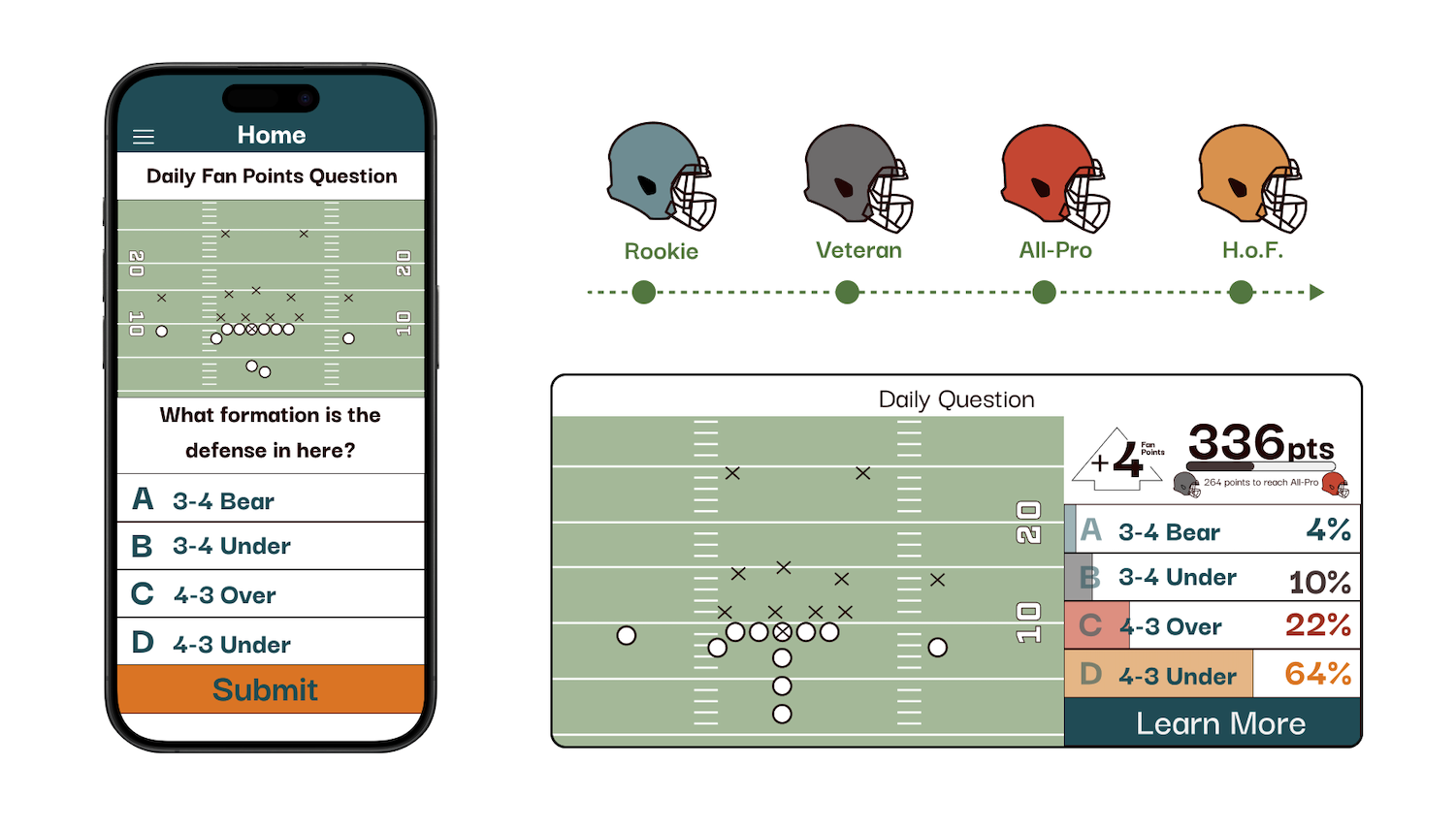
Fans are encouraged to engage with the platform through a set of daily questions designed to help fans learn more about the game of football and the history of the NFL and that offer opportunities for fans to earn Fan Points and progress along the path towards becoming a Hall of Fame level fan.

These Fan Points also fuel the Fan Rankings, allowing fans to see where they stack up individually among other fans - filterable by team, group, and location - as well as where the Fan Groups they have joined stack up against other team’s Fan Groups in their area, and eventually other fan groups of their team around the country or the world!

Finally, for new fans or fans who just want to learn the basics or more seasoned fans who want to brush up on their football knowledge, the Learning Center provides a great resource for information about the rules and strategy of NFL football.
Testing

I utilized the Testing Table and Test Cards from Strategyzer to set up and organize the prototype testing and results. This brought focus to the testing methods and helped me establish which metrics I would use to determine whether this service concept might be a success.

I ran participants through a Wizard-of-Oz style placement exam to give them an initial Fan Level placement before moving the users through the rest of the prototype and collecting their feedback.

Testing results indicated a high level of trust in the initial placement exam to sort fans appropriately, a willingness to spend $5/month on a service like this, and an eagerness to engage at least 1x/day.
Next Steps
Running this project alone meant owning every decision, from who to survey to what to cut from the MVP. The diary study taught me the most: what fans said they wanted on day one was often different from what they kept coming back to by day ten. Based on feedback from concept testing, a larger emphasis is needed on player, team, and league history. Including player, team, and league history in the initial placement exam, daily questions, and the learning center will allow a broader array of fandoms to be taken into account throughout the service.

As the service is developed, the focus should start with the initial offering, which should include the Fan Levels system, daily trivia questions, fan and fan community rankings, the Learning Center, user profiles, fan community pages, event pages and planning, and discussion threads. This initial offering would be launched in major cities with NFL teams to establish a strong user base.
As the user base grows, the service can develop more features like learning modules, an AI “assistant coach”, and fan challenges. We can also establish partnerships with industry professionals and local venues to host fan events and challenges. Down the road, as the service gains market leverage, we can look to partner with the NFL and NFL teams, establish virtual meet and greets with fans, players and personnel, and fan “bar takeovers” for fan community watch parties.